The Detailing Business Equipment List That Actually Pays for Itself
Most detailers buy equipment in the wrong order. They're $4,000 deep in polishers and pad kits before they've got a single recurring client — then wonder why the business feels like an expensive hobby.
TL;DR
- Buy equipment in revenue-generating order, not excitement order
- A carpet extractor at $800 unlocks $150–$250 interior shampoo jobs — it pays for itself in 4–6 jobs
- A Rupes LHR15 at $500 is a luxury until you're booking paint correction regularly
- The two-bucket method and a quality wash mitt close more jobs than a $1,200 foam cannon setup
- The goal is equipment that pays you back within 30 days of purchase
The gear obsession is real in detailing. Forums full of Rupes vs. Flex debates. YouTube channels dedicated to which foam cannon throws the best suds. None of that is the conversation a shop owner should be having.
The question is not "what's the best polisher." The question is "which piece of equipment generates the most margin per dollar spent, right now, at my current revenue level."
That's a different conversation. This article is that conversation.
Why Most Detailing Equipment Lists Get It Wrong
The top search results for "detailing business equipment list" are affiliate link roundups. They list 25 products, drop Amazon links, and tell you to "invest in quality." Written for gear enthusiasts, not business owners.
Here's what they miss: equipment has a break-even point. Every piece of gear you buy needs to pay for itself before it starts generating profit. If a $400 pressure washer takes 8 jobs to recover its cost, and you're doing 4 jobs a month right now, that's a 2-month payback period. Fine. If a $2,000 rotary polisher takes 20 paint correction jobs to recover — and you're booking one paint correction per month — that's 20 months before it contributes to profit.
Sequence matters. The equipment you buy first should generate revenue fast and frequently. The specialty gear comes after the base is stable.
Phase 1: The $1,500–$2,500 Starter Stack (Gets You Booked)
This is the equipment that lets you take money tomorrow. Nothing on this list is a luxury purchase. Everything generates revenue within the first few jobs.
Pressure Washer — $300–$600
The foundation of every exterior service. A 1,600–2,000 PSI electric unit works for residential and mobile. Gas if you're doing fleet. The Ryobi 1600 PSI electric is a legitimate business tool at $220 — not the $800 Stihl, but it runs daily without issues for the first year.
The mistake: going straight to a $900 gas pressure washer because "pros use gas." Gas is faster for heavy work, but the $600 difference buys your first 100 microfiber towels and chemicals for the first month.
Dual-Action Polisher — $150–$250
Not a Rupes yet. The Chemical Guys Torqx ($160) or the Flex XCE 10-8 ($230) handles paint correction on 80% of the vehicles you'll see at this stage. You're not doing multi-stage correction on a $50k Ferrari right now. You're doing $150 paint correction add-ons for customers who found you on Google.
A DA polisher at this level pays for itself in 2–3 paint correction upsells. Keep it simple.
Wet/Dry Vacuum — $120–$200
Ridgid 9-gallon, Shop-Vac, or Craftsman. These run forever, pull hard, and cost nothing to maintain. The $500 Blaster Vac is a year-two purchase. At month one, a $150 shop vac does the job.
Microfiber Towels — 50-count set, $80–$120
Buy quality once. Chemical Guys, The Rag Company, or Autofiber. 380–470 GSM for drying and finishing, 200–280 GSM for glass and quick wipe. Low-GSM towels scratch paint. Buy the right ones and wash them correctly — they last 200+ washes.
One variable people overlook: use a dedicated towel washing bag, Micro-Restore detergent, and air dry. Towels contaminated by dryer coating residue leave swirl marks. A $12 variable that protects $200 worth of towels.
Wash Mitts and Buckets — $40–$60
Two buckets minimum. One for wash solution, one for rinse. Grit guards in both. A quality microfiber or chenille wash mitt ($15–$25) from The Rag Company or Autofiber. The two-bucket method prevents the swirl marks detailers create themselves — and it signals professionalism to clients watching the process.
Chemical Kit — $200–$300 to start
You need car wash soap, APC (all-purpose cleaner), iron remover, tire dressing, glass cleaner, and a finishing spray. Do not buy 8 different waxes. Buy one quality paint sealant (Gyeon Cure, CarPro Reload, or Meguiar's M21) and one ceramic spray coating (Gtechniq C2v3 or Adam's Ceramic Spray Coating). These apply in 10 minutes and add $30–$50 to any detail.
Phase 2: The Equipment That Unlocks Higher-Margin Services ($800–$2,000)
Once you're consistent — 8–12 jobs per month, clients coming back — these are the purchases that let you charge more per job.
Carpet Extractor — $600–$1,200
This is the single most important equipment upgrade for revenue. Here's the math:
A basic interior detail runs $100–$150. Add carpet and upholstery extraction, and that same job becomes $200–$300. The extractor costs $600–$800 for a quality unit — the Mytee Escape 8070 is the standard mobile-friendly unit at around $700–$800. If budget is tight, the Bissell Big Green Commercial runs $350 and handles residential interiors well.
Break-even calculation: At $100 per extraction add-on, a $700 extractor pays for itself in 7 jobs. At 8–10 jobs per month, you're profitable on this tool within 3–4 weeks. No other piece of equipment at this price point generates a faster payback.
Steamer — $400–$800
A dry vapor steamer replaces half your chemical cabinet for interior work. It kills bacteria, removes stains without soaking carpet, and handles leather conditioning prep. The difference between a $150 interior and a $250 interior is often the steamer — it gets into vents, seams, and cup holders that chemicals and towels miss.
The Fortador Volt Mini at $700 is the professional standard for mobile operators. The Dupray Neat at $400 works for light-to-medium volume. Either pays for itself in 4–6 weeks at consistent interior volume.
Foam Cannon — $60–$150
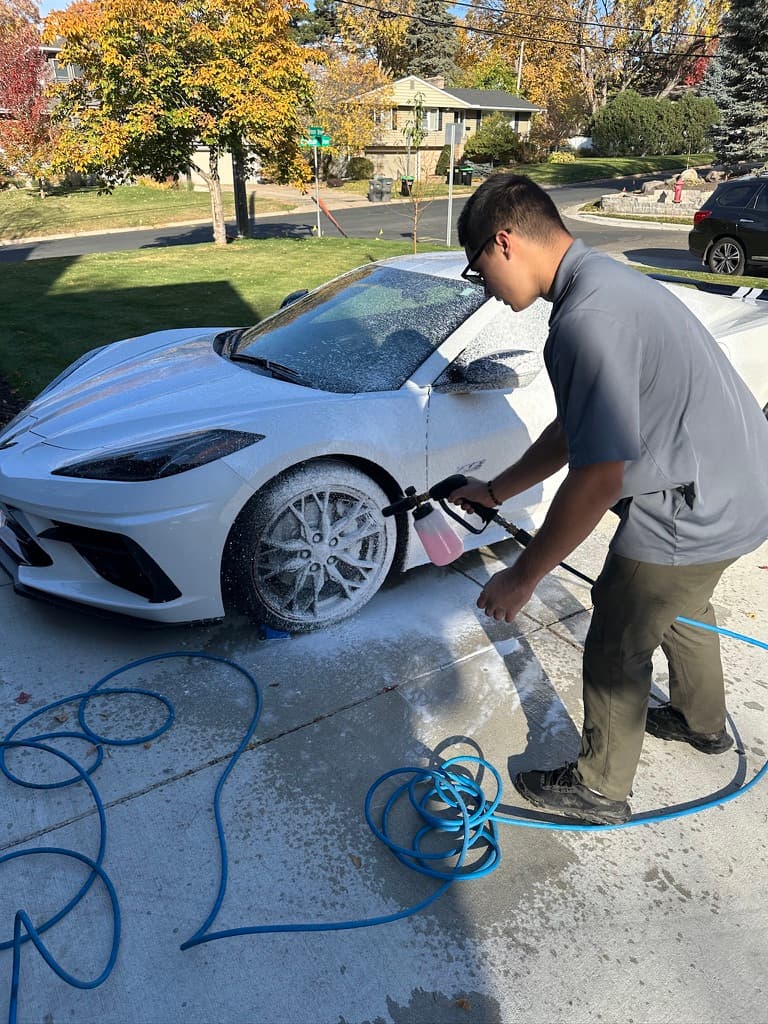
Not a Phase 1 purchase. A foam cannon is a pre-wash tool — it softens and lubricates contaminants before the contact wash. That's it. It does not clean the car. It makes the wash safer.
The Adam's Standard Foam Cannon ($80) or Chemical Guys TORQ Professional Foam Cannon ($90) are more than enough. Avoid the $20–$30 Amazon specials — nozzle threads strip within 60 days.
Lighting — $150–$400
Paint defects hide in bad light. A dedicated work light — the Scangrip Multimatch 3 at $350, or two $75 LED shop lights on stands — reveals scratches, swirl marks, and contamination that overhead garage lighting misses.
This matters for paint correction quotes. You cannot confidently charge $300 for a correction you did not fully see. Good lighting also signals professionalism to clients who watch the inspection process.
Phase 3: High-Ticket Service Equipment ($1,500–$5,000)
These tools separate a $10k/month shop from a $20k/month shop. None of them make sense before Phase 2 is stable.
Professional DA Polisher — $400–$600
The Rupes LHR15 Mark III ($500) or Flex XFE 7-15 150 ($450) is what paint correction at $300–$700 per job requires. These machines cut faster, finish cleaner, and hold up to daily use in ways a $200 DA cannot.
The Rupes LHR15 specifically: the 15mm orbit removes compounding work faster than a standard DA, cutting a full correction from 7–8 hours to 4–5 hours. That is $40–$60 of labor savings per job, plus the capacity to handle more vehicles per week.
When to buy: once you're booking 4+ paint corrections per month at $250+. At that volume, the Rupes pays for itself in 6 weeks. Before that, the Phase 1 DA is fine.
Ceramic Coating Application Kit
One ceramic coating job at $600–$1,500 nets the same margin as 15–20 standard washes. If you're not selling ceramics, that math alone is the reason to start.
Required: suede applicators ($25 for a 10-pack), a professional-grade coating (Gtechniq Crystal Serum Light or CarPro Cquartz at $80–$150 per bottle covering 1–2 vehicles), and proper wipe cloths. The coating itself is not expensive. The labor and environment are — ceramic application requires 60–70°F, low humidity, no direct sunlight. A garage or enclosed space is non-negotiable for consistent results.
The certification is worth $200–$400 (Gtechniq, IDA ceramic programs, CarPro). It teaches flash time, panel prep, and leveling technique — the variables that separate a $200 coating job from a $1,200 one.
Pressure Washer Upgrade — $600–$1,200
When fleet work becomes regular — trucks, work vans, construction equipment — a 3,000 PSI gas pressure washer (Simpson Cleaning MSH3125-S, Karcher G 3200, or Generac) cuts wash time by 30–40%. At 10+ fleet vehicles per session, this is a labor-cost decision, not a gear upgrade.
What to Skip (At Least for Now)
Ultrasonic ceramic coating booths: $3,000–$8,000. For a shop doing fewer than 10 ceramics per month, this does not pencil.
Paint thickness gauges: Useful for paint correction pricing. Not urgent until you're regularly quoting heavy corrections. A decent unit runs $200–$350 (Elcometer 456, PosiTector 200).
High-end vacuum systems (Blaster, Tornador combo): The Tornador foam gun at $150 is a legitimate time-saver for interior cleaning. The Blaster vacuum at $600+ is a year-three purchase for high-volume shops.
Polisher collections: You need one good DA and eventually one good rotary. You do not need five polishers. Most detailers who own six machines are collecting gear, not running a business.
The Equipment Budget Model by Revenue Stage
| Monthly Revenue | Equipment Budget | Priority Purchase |
|---|---|---|
| Under $3k/mo | $1,500–$2,500 total | Starter stack: pressure washer, DA, vacuum, chemicals, towels |
| $3k–$7k/mo | +$800–$1,200 | Carpet extractor — single biggest margin unlock |
| $7k–$12k/mo | +$400–$700 | Steamer + professional lighting |
| $12k+/mo | +$500–$1,000 | Rupes-tier polisher, rotary for heavy correction work |
Match equipment investment to service demand. Do not buy a ceramic booth before you're consistently booking ceramics. Do not buy a Rupes before you're filling your correction calendar.
The Break-Even Formula for Any Equipment Purchase
Run this before every purchase:
- What service does this enable or speed up?
- What is the price increase per job when I have it?
- How many jobs per month will use it?
- Price ÷ (jobs × revenue increase) = weeks to break even
If break-even is under 8 weeks at your current volume, buy it. If it's over 6 months, wait until your volume grows into it.
Example — carpet extractor: $700 ÷ (8 jobs × $100 extraction add-on) = 0.875 months. Buy it.
Example — Rupes LHR15: $500 ÷ (1 paint correction/month × $50 upcharge over current polisher) = 10 months. Wait.
The math does not lie. It just requires you to know your numbers.
Equipment Is Infrastructure, Not the Business
Gear doesn't close jobs. Systems do.
You can have a perfect equipment setup and still be losing 40–50% of your inbound leads because you're not responding within 5 minutes. You can have the best ceramic coating setup in your market and still undercharge because you don't have a structured quote process.
The detailers running $20k+ per month are not always running the most advanced equipment. They're running consistent systems — fast lead response, structured packages, follow-up sequences that convert estimates into booked jobs.
Before you spend another dollar on equipment, find out where your revenue is actually leaking. The free audit at detailpro.click/audit takes 4 minutes and shows you exactly which part of your operation — not your gear — is costing you the most money.
For equipment standards and certification programs in professional detailing, the International Detailing Association at the-ida.com maintains industry guidelines and approved product categories for certified detailers.