Detailing Business Burnout: It's Not a Mentality Problem
Burnout ends more detailing businesses than bad marketing ever will. And the advice most detailers get when they hit it is completely wrong.
TL;DR
- Detailing burnout is caused by structural problems — no systems, no delegation, no recurring revenue — not weak mindset
- The technician trap: your income stops the moment your body does
- Three specific systems (auto-reply, recurring clients, tiered pricing) reduce physical workload without reducing revenue
- The fix isn't taking a vacation — it's removing yourself from the parts of the business that don't require your hands
- Detailers who build systems work fewer hours at higher revenue; detailers who grind harder work more hours at the same revenue
Why Detailers Burn Out (And It Has Nothing to Do With Passion)
You didn't lose your passion for detailing. You lost your tolerance for running a business that requires your physical presence every single day just to keep the lights on.
That's a different problem. And it has a different solution.
The standard advice — "take a day off," "remember your why," "practice gratitude" — treats burnout like a software bug that a firmware reset can fix. It can't. When your income stops the moment your hands stop, a weekend off doesn't fix anything. It costs you money and delays the crash by about four days.
The detailers who escape burnout don't find a new mindset. They build a different structure.
What Detailing Burnout Actually Looks Like
The pattern is almost always the same:
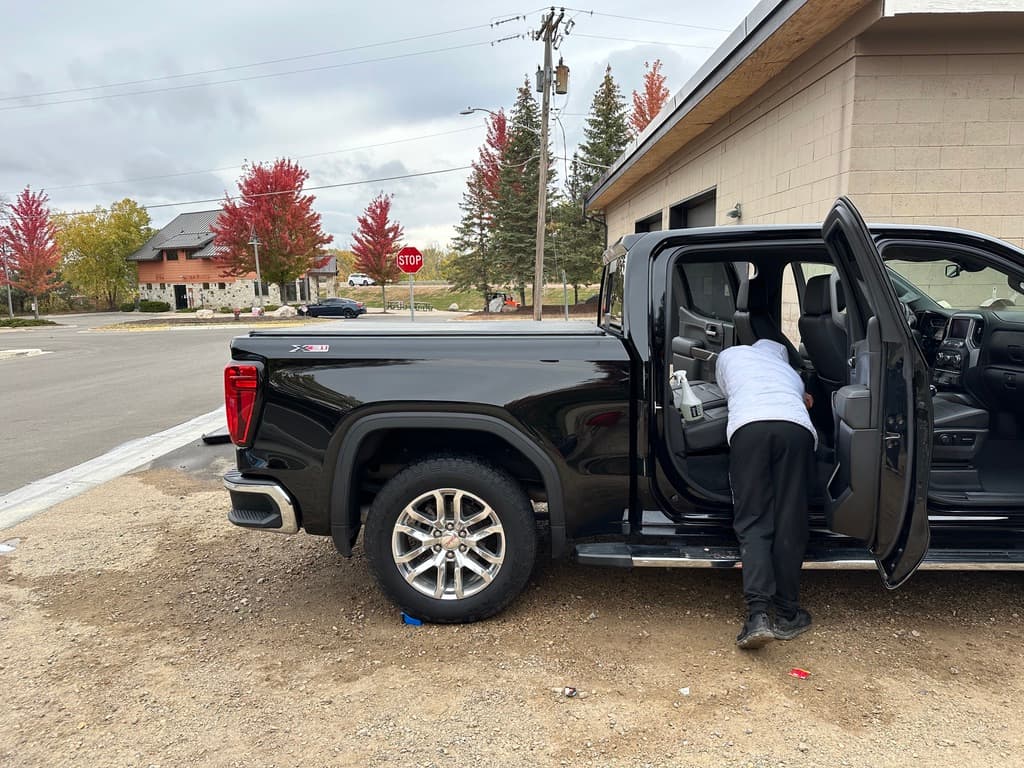
You're doing $8k–$12k a month. Booked out two weeks. Physically grinding through 10–12 hour days in heat, chemicals, on your knees for paint corrections. Body aches. You can't answer the phone while you're working a detail, so leads go cold. You text them back at 10pm. The business exists entirely inside your head and your body.
Then a slow week hits. The psychological crash is disproportionate — not just to the revenue dip, but to the physical exhaustion underneath it.
Real detailer quote from the r/Detailing community: "I'm just completely burnt out and don't want to do it anymore… I've taken time off and all I did the whole time was try to figure out what else I could do for work."
That's not someone who lost their passion. That's someone whose business model has a structural flaw — one where the owner is the bottleneck in every single process.
The Real Cause: The Technician Trap
What is the technician trap? The technician trap is when a detailing business owner functions primarily as a skilled laborer rather than a systems manager — meaning revenue depends entirely on their physical labor. When the owner stops working, revenue stops. This model creates burnout because income and physical output are permanently coupled.
Every hour you spend with a buffer pad in your hand is an hour you're not building anything. You're trading time for dollars in a model where there's a hard ceiling on how many dollars a single body can earn in a single day.
The math is brutal. At $150/hour, a 10-hour day is $1,500. Less product, gas, time driving. You can't meaningfully scale that number without either raising prices (which takes a system) or adding bodies (which takes a different system). Most detailers do neither — they just grind harder until they break.
The technician trap has three symptoms:
- Revenue is unpredictable month to month — feast and famine, no baseline
- Scheduling happens through your personal phone — texts, DMs, no automation
- Every lead requires your personal attention — you are the entire sales process
If two or more of those describe your business, burnout isn't coming. It's already here or it's scheduled.
The Three Systems That Break the Cycle
You don't need to stop loving detailing. You need to stop being the only thing standing between your business and collapse.
Here are three structural changes that reduce physical and mental load without reducing revenue:
1. Automate the First Touch
You're losing leads right now because you're physically on a car when they come in. The 5-minute response window is real — a lead that doesn't hear back within five minutes is statistically likely to call the next detailer on the list.
An automated reply — a real one, not a generic "we'll be in touch" — can respond, qualify the lead, and collect key job details before you ever pick up the phone. Set it up once. It runs every time.
This removes one of the highest-stress parts of the day: the mental load of keeping track of who texted, who called, who you haven't followed up with yet. That mental overhead is a significant contributor to burnout.
What to automate:
- Initial inquiry response (within 60 seconds)
- Quote follow-up at 24 hours and 72 hours
- Booking confirmation and day-before reminder
That's three automations. Combined, they handle roughly 80% of your client communication touchpoints — without you touching your phone.
2. Build a Recurring Revenue Floor
The psychological crash of a slow week is worse than the financial impact. When revenue is completely project-based, every lull feels like the business is dying.
Fleet accounts change this.
One fleet client — a property management company, a landscaping company, a real estate agency — can generate $500–$2,000 per month on a recurring contract. Four fleet clients is a $2k–$8k baseline before you book a single retail job.
That baseline fundamentally changes your relationship with slow retail weeks. They stop being existential threats and start being inconveniences.
The fleet acquisition process is specific and repeatable. Cold outreach to local businesses with 3+ company vehicles, a fixed-price monthly contract, one billing date. The work is often less intensive than high-end retail — washes, interior wipe-downs, quarterly deeper cleans. It's also predictable, which is the point.
Recurring revenue doesn't just help with cash flow. It reduces the cortisol load of running the business. That matters.
3. Charge for Ceramic, Not Just for Washes
This is a structural pricing problem as much as a burnout problem.
One full ceramic coating job — prep, decontamination, application, cure — generates the same net profit as 40–50 basic washes. If you're filling your calendar with washes and maintenance details, you're maximizing physical output and minimizing margin. That's the worst possible trade.
Shifting your pricing mix toward higher-ticket jobs means fewer cars, fewer physical hours, and the same or better revenue. This isn't about being "premium" for its own sake. It's arithmetic.
The car detailing pricing guide breaks down how to structure tiered pricing so high-ticket services are the natural choice, not the upsell.
A detailer doing six ceramics per month at $1,200 average works fewer hours than one doing twenty-five washes at $200 average — and nets roughly the same revenue. The wash-volume model is a direct path to the kind of physical breakdown that ends careers.
Why "Take a Vacation" Doesn't Fix It
Taking a week off when you're burned out in a business with no systems is like taking ibuprofen for a broken arm. It manages the symptom for a few days. The underlying problem is still there when you come back — plus you're now behind on messages, quotes, and follow-ups.
The detailers who report lasting relief from burnout almost always made a structural change, not a mindset shift. They hired someone. Or they built automation. Or they landed a fleet contract that gave them a floor. Or they raised prices and dropped their volume.
The International Detailing Association has addressed this directly — their research shows that detailing professionals who implement operational systems report significantly lower rates of career exit due to physical and mental fatigue compared to those operating without them. The mechanism isn't mysterious: when you're not the single point of failure in every process, the load distributes.
Wanting to work less and earn the same isn't laziness. It's business literacy.
What the Other Side Looks Like
The detailers who've built through burnout describe a specific feeling: the business still runs when they take a day off.
Not because they hired a full team. Because they systematized the parts that don't require their hands — lead capture, follow-up, scheduling, invoicing — and now those parts happen automatically.
They still detail cars. They just don't have to detail cars to keep the lights on.
That distinction is everything. When working is a choice, the work itself stops feeling like a trap. The craft comes back. The burnout doesn't.
One detailer put it plainly: "The dream is freedom — the ability to work if I want or don't want to without the business stopping entirely."
That's not a personality type. That's a system.
The Next Move
Identify the single biggest drain on your time and mental energy right now — responding to leads, chasing unpaid invoices, rebuilding your schedule from scratch every Monday, working through slow months with no baseline income.
Pick one. Build a system around it.
You don't need a complete overhaul. You need one structural change that removes you from one high-friction process. That's the start of the exit from the technician trap.
If your biggest drain is lead management and follow-up — the one that keeps you texting at 10pm — see how DetailPro automates that process for detailers specifically.
The business should run the day. Not the other way around.