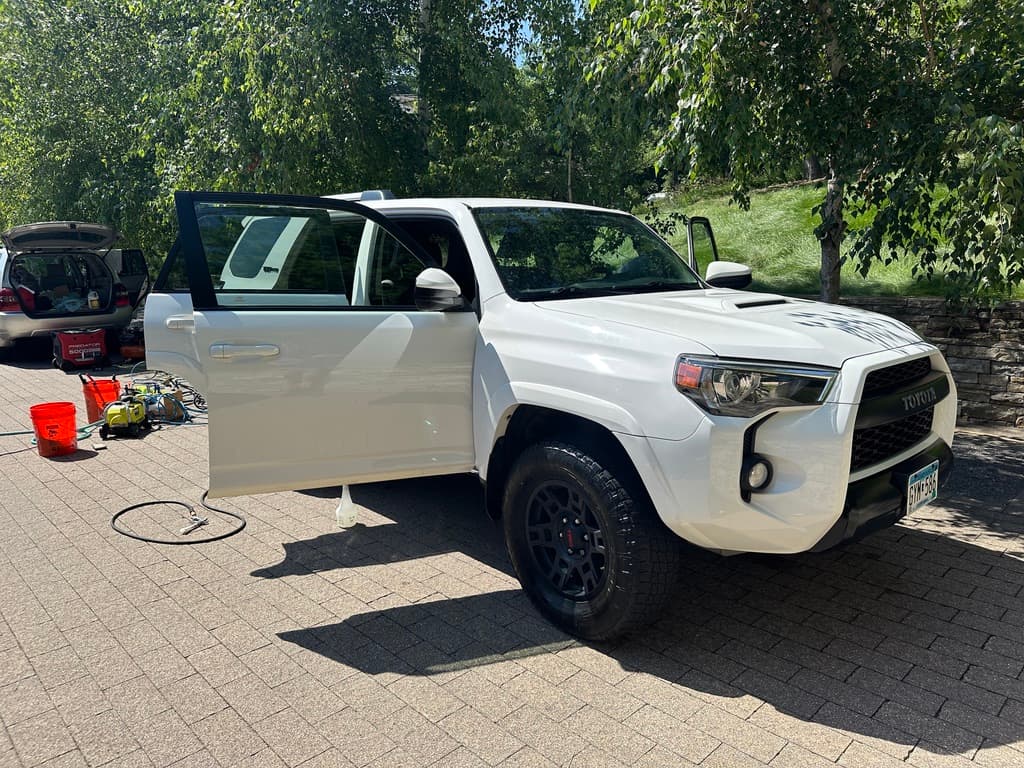
Car Detailing Referral Program: The System That Fills Your Schedule With Pre-Sold Clients
Your happiest customers already want to send you more business. Most detailers just never make it easy enough for them to do it.
TL;DR
- A structured referral program turns one satisfied client into a predictable lead source, not a random one
- The best detailing referral rewards are simple: cash credit or a free service tier — not points, gift cards, or complexity
- Timing the ask matters more than the incentive — the window is 24–48 hours after the detail, not weeks later
- Without a follow-up system that sends the referral request automatically, most detailers collect referrals only occasionally and inconsistently
- The highest-converting referral asks combine a photo of the finished car, a direct link, and one sentence — not a paragraph of text
Word-of-mouth has always been the best lead source for detailers. The problem is that most shops treat it like luck instead of a system.
A client finishes a ceramic coating job on their Silverado and drives out looking like it just rolled off the lot. Three of his coworkers ask him who did it. He tells two of them. One texts you. You're busy under another car and respond four hours later. He already booked somewhere else.
That is not a referral problem. That is a systems problem.
This guide walks through how to build a car detailing referral program that runs on its own — so when happy clients want to send you business, there is a clear path for them to do it, a reason to do it now, and an automatic follow-up that makes sure nothing gets dropped.
What Is a Car Detailing Referral Program?
A car detailing referral program is a structured system that rewards existing clients for sending new customers to your shop. When done right, it turns a single completed job into an ongoing lead source — with no ad spend required. Referral leads close faster, complain less, and have higher average ticket values than cold traffic.
Generic referral advice treats it like a marketing tactic. It is actually a retention and conversion system. A referred client arrives pre-sold. They trust you because someone they trust trusted you first. Your close rate on referral leads should be 60–80% compared to 20–30% on cold ad traffic.
That gap is why a referral program deserves a real system — not a handshake and a hope.
Why Most Detailer Referral Programs Fail
The most common setup: you verbally tell clients "send me your friends and I'll take care of you." Maybe you say it at pickup. Maybe you put it on your invoice footer.
This fails for three reasons.
No clear incentive. "I'll take care of you" is not an incentive. It is a vague promise that your client will forget by tomorrow. Specificity closes loops: "$50 off your next detail for every client you send" is a reason to act.
No easy path. Even motivated clients will not send referrals if the process requires effort. Asking someone to "just tell your friends" puts all the work on them. A direct booking link, a pre-written text they can forward, or a QR code on the door panel sticker removes friction.
Wrong timing. Most detailers mention referrals once — at pickup, when the client is distracted by their freshly cleaned car. The highest-converting window is 24–48 hours after the detail, when the client has already shown their car to someone and gotten compliments. That is when they are emotionally ready to share.
Fix all three and referrals stop being random and start being consistent.
The Two Reward Structures That Actually Work
Option 1: Cash Credit
Straightforward and high-perceived value. The referred client completes a service, and the referring client receives a credit applied to their next booking.
Recommended amounts by service tier:
| Referring client sent... | Reward |
|---|---|
| A wash or interior detail | $25 credit |
| A paint correction | $50 credit |
| A ceramic coating or PPF | $75–$100 credit |
This scales reward to the value of the job — someone who sends you a $2,000 ceramic coating client is worth more than someone who sends you a $150 detail, and your reward structure should reflect that.
Do not offer cash. Credit keeps money inside your business, creates a reason for the referring client to come back, and avoids the awkwardness of Venmo'ing customers.
Option 2: Service Tier Upgrade
Alternative to cash: reward the referring client with a free add-on on their next visit. Examples: free engine bay clean, free clay bar treatment, free interior odor treatment. This costs you less than face value and still feels premium to the client.
Works well for clients who get detailed regularly — they book knowing the upgrade is waiting for them.
The Referral Ask: Timing and Delivery
The ask is more important than the incentive.
Step 1: Send the final photo with the referral link (24 hours after pickup)
The day after a detail, send a follow-up message with a photo of their car at delivery and a one-sentence referral ask. This is the peak sentiment window — they woke up that morning, walked to their car, and remembered how good it looked.
Example message:
"Hey [Name] — wanted to drop you that photo from yesterday. If anyone sees the car and asks who did it, send them this link: [direct booking link]. You'll get $50 off your next service when they book."
Short. Direct. Has a photo. Has a reason to act. Has a link. No paragraph of explanation needed.
Step 2: Add a door panel sticker with a QR code
A clean sticker on the inside of the driver's door — where the VIN sticker lives — with your logo, a QR code linking to your booking page, and "Ask me who detailed this car." This works passively every time someone rides in the vehicle.
Cost: $0.10 per sticker at any print shop. Impact: indefinite passive referral surface on every car you touch.
Step 3: Seasonal reminder at 90 days
At 90 days post-service, send a reactivation message reminding the client their referral credit is active. Many clients intend to refer but forget. A 90-day nudge catches them at the point where they are starting to think about their next detail anyway.
How to Automate the Referral Follow-Up
Manual referral programs collect referrals inconsistently. Automated ones do it every time.
The automation sequence has three messages:
- Day 1 (post-service): Photo + referral ask with link + reward amount
- Day 7: Brief check-in + reminder that the referral link is active
- Day 90: Reactivation message — "Your referral credit is still waiting. Ready to book?"
This runs without you touching it. A detailer using a CRM with automation built in can set this up once and have it trigger on every closed job. If you have not set up automated messaging yet, the auto-reply guide for detailers has the exact message templates.
The key mechanic: every message should contain the direct booking link. Not "reach out to me" — a link they can forward, tap, or hand to someone else. Reduce every step between "intend to refer" and "referral booked."
For detailers using SMS-based follow-up, response rates on Day 1 post-service messages run 40–60%. Compare that to a cold Facebook ad click converting at 1–3%.
How to Track Referrals Without Overthinking It
You do not need complex software to track referrals at the early stage.
The simplest system: give each client a unique booking link or promo code tied to their name. When a new client books using that link or code, you know who sent them. Mark the credit in your CRM or a simple spreadsheet. Apply it at their next service.
As your volume grows, look for a booking system that handles attribution automatically — where referred clients are tagged at booking and credit is applied without manual tracking.
The reason most referral programs break down is not bad intentions — it is that tracking becomes a chore and the owner stops following through on rewards. Automation removes the chore.
What to Say on Your Booking Page
Your booking page needs a visible referral section. One line is enough:
"Referred by a friend? Enter their name at checkout. They'll get $50 off their next service when you book."
This does three things:
- Confirms to the new client that they are making the right choice (social proof)
- Gives the referring client credit for the send
- Creates a reason for both parties to complete the booking
Put this above the booking form, not below it. Most clients do not scroll past the form.
Referral Program Mistakes to Avoid
Asking too early. If you ask for a referral during the service or at drop-off, the client has not yet experienced the result. The referral ask should come after they have lived with the clean car for at least one day and talked to someone about it.
Making the reward too complicated. Points systems, tiered loyalty cards, and app-based rewards are for national chains with marketing departments. You are a detailing shop. "$50 off, no expiration" is better than any gamification system.
Not following through on rewards. One unfulfilled credit destroys the program. If someone sent you a $1,500 ceramic job and never got their $75 credit applied, they will not refer again. And they will tell people. Track every referral credit, apply it without being asked, and confirm it in a message.
Treating it as optional. A referral program that only activates when you remember to mention it is not a program — it is a conversation topic. The system has to run the same way every time, with every client, automatically.
Pairing Your Referral Program With Your Full Follow-Up Sequence
A referral program works best when it sits inside a broader client follow-up sequence. The logic:
- Post-service Day 1: photo + referral ask
- Post-service Day 7: review request (Google or Facebook)
- Post-service Day 30: check-in / next service reminder
- Post-service Day 90: reactivation + referral credit reminder
Each message has one job. None of them ask for multiple things at once. The referral ask and the review ask are separated because asking for both in the same message dilutes both.
The International Detailing Association recommends building a client communication cadence into standard operating procedures for any shop pursuing repeat business — referrals are more reliable when follow-up is treated as an operational standard, not a marketing afterthought.
If you are still building out your follow-up cadence, the detailing customer retention guide covers the full reactivation sequence. And if you are running a mobile detailing business, the door panel sticker approach is especially effective — every job site is a new audience.
How Many Referrals Should You Expect?
At steady state, a well-run referral program converts 10–20% of completed clients into active referrers — meaning they send at least one new client within 90 days.
In a shop doing 30 jobs per month, that is 3–6 referred clients added to your pipeline every month.
At an average ticket of $300–$500, that is $900–$3,000 in additional monthly revenue. No ad spend. No agency fee.
The ceramic coating tier amplifies this significantly. A ceramic client who sends you one referral on a $1,800 job at $100 credit cost just made you $1,700 net new revenue before you spent a dollar on ads. One in five clients doing this changes your monthly revenue without running a single campaign.
That is not a marketing win. That is a systems win.
Referral Program Quick-Start Checklist
Run through this once to build the foundation:
- Decide your reward structure (cash credit or service upgrade)
- Set reward amounts by service tier (use the table above as a starting point)
- Create a direct booking link — not your homepage, a booking form
- Write your Day 1 message template (photo + one sentence + link + reward)
- Order door panel stickers with your logo and QR code
- Add a referral field to your booking page ("Referred by?")
- Set up the 3-message automation sequence in your CRM
- Confirm you have a tracking method — link codes, promo codes, or a log
That is the whole system. Each piece has a clear job. None of it requires a marketing degree.
If you are doing the first few steps manually while you build toward automation, that is fine. The important thing is that the Day 1 follow-up message — the one with the photo — goes out consistently. Everything else can layer on top of that.
Next Step
If you have clients who are happy with your work and you do not have a structured referral program, you are leaving bookings on the table every week.
Set up the Day 1 post-service message today. One message, one link, one reward amount. Run it manually if you have to. Once you see what consistent follow-up does to your referral volume, you will automate the rest.
If you want the whole sequence — referral ask, review request, reactivation, and rebooking — running automatically off every closed job, that is what DetailPro's follow-up system is built to do. Book a strategy call to see how the shops using it are filling schedule gaps without spending more on ads.